A Political Staging of The Nutcracker
Every December, The Nutcracker returns. Snowy and sparkly, year after year, it feels suspended in 1820s Germany with the classic story and Tchaikovsky’s period soundtrack. Yet, despite its timeless feel, The Nutcracker costumes have repeatedly transformed, absorbing the political values of the societies that stage it, particularly during the Cold War.
For instance, the Soviet Union dressed its ballerinas with emphasis on the cohesive ensemble over individual spectacle, designing corps de ballet costumes for visual unity rather than cultural flair. As seen in this picture, Soviet productions favored uniform silhouettes, ensuring that dancers were read as a coordinated whole rather than individual ones. This costuming choice was not only an aesthetic move, but a political one, aligning with the Soviet ideological commitments to collectivism and discipline.
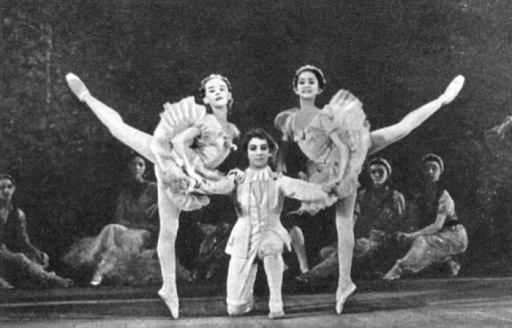
Photo: Soviet Art
Meanwhile, and in contrast, American Nutcracker productions hyper-individualized their characters—Candy Canes, Dew Drops, Flowers—with playful and cartoonish exaggeration. Although this image dates back to the first American Nutcracker in 1944, three years before the onset of the Cold War, it already demonstrates aesthetic tendencies that would later define Cold War–era American ballet. Here, the Sugar Plum Fairy’s voluminous skirt, velvet leotard, and aristocratic crown sharply distinguish her from Coffee, whose costume relies on culturally approprative (and inaccurate) Arabian fashion. Together, these costume choices reflect an American self-fashioning that emphasized abundance, visual excess, and expressive freedom during the Cold War.
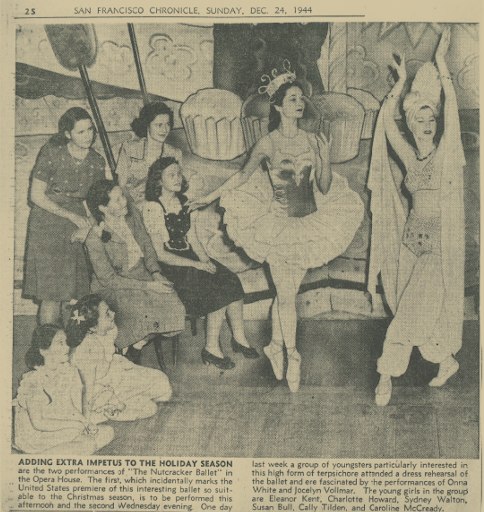
Photo: America’s First Nutcracker
Looking ahead, in light of the ongoing conflict between Russia and Ukraine, The Nutcracker invites renewed attention to how shifting relationships between the United States, Russia, and Ukraine may continue to surface quietly through costume and staging.
XOXO, The Fashion Stock Market
Cover Photo: Theater Times
Editor: Felicity Field