Fashion does not always begin on a runway. Sometimes, it begins in an alleyway, in a garage, in a space not designed for it, and perhaps not meant to contain it.
That is where Te Wiki Āhua o Aotearoa exists.
Held in Tāmaki Makaurau, the underground fashion week was created to give emerging Māori, Pacific and local creatives a space to enter an industry that has historically been difficult to access. Across nine days, from March 20 to 28, the event hosted 16 shows, not in polished venues, but in places that demanded attention: a dilapidated garage, an industrial-style church, a skate park.
The setting was not incidental. It was part of the message.
Fashion You Can Touch
From the beginning, the tone was clear. This was not a fashion week interested in spectacle for its own sake, but in presence, in making fashion feel tangible again.
Pre-show announcements rejected the growing dependence on artificial intelligence and emphasized the value of human craftsmanship. Designers were described not simply as makers of clothing, but as “poets of the tactile,” their work defined by touch, labor, and intention.
Everything reinforced this idea. Programmes were printed like newspapers. Letters were handwritten with ink and quill. Guests interacted with physical objects — wax-sealed notes, magazines, wired headphones — in ways that resisted the speed and detachment of digital culture.
Even as social media documented the event, the experience itself insisted on something slower, more deliberate.
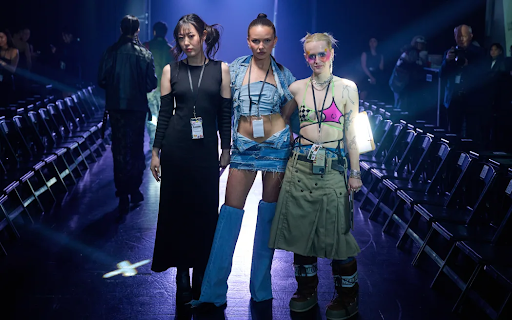
Photo: Ryan McKenna/Ryan Patrick Photography
A Growing Presence
By its fourth edition, Te Wiki Āhua o Aotearoa has expanded in scale and influence. Designers with established local recognition presented new collections, while collaborations with retail spaces signaled a growing connection between underground creativity and the broader fashion market.
This expansion raises a question: what does “underground” mean when visibility increases?
Perhaps here, it is less about scale and more about intention. The designers do not reject the industry, they reshape how they enter it.
How They Want Us to Dress
Across the week, a clear direction emerged. Not a single trend, but a set of attitudes.
With Sensuality
Movement was central. Collections emphasized the body not through structure, but through fluidity, sheer fabrics, lace, velvet, and low-cut silhouettes that followed motion rather than restricting it.
Fringes Garments, opening the week with The Way She Moves, leaned into a grungy, monochromatic sensuality, where cut and texture defined presence. The garments did not overwhelm the body; they amplified it.
Elsewhere, materials shimmered and shifted, allowing choreography to become part of the design itself. Clothing was not static, it responded.
With Presence
If sensuality was about movement, presence was about control.
OOSTEROM’s ALLA PRIMA introduced a quieter kind of power, rooted in slow fashion. Structured coats, hand-cut details, and deliberate silhouettes created a sense of stillness that demanded attention.
Similarly, collections across the week used shape to assert authority. Volume, sharp tailoring, and restrained color palettes allowed garments to occupy space without excess.
Presence here was not loud. It was precise.
With Rebellion
At the same time, rebellion ran through the programme.
Laurence Sabrine’s Work Till We Drop deconstructed uniformity, reimagining school dress codes through asymmetry, distortion, and irony. The collection disrupted the idea of discipline by exposing its limits.
In the A Lot of Littles is a Lottle showcase, designers like STANG and Sherbert Lemon pushed this further. Knitwear carried direct messages — “Unionise,” “Vote!” — while hyper-feminine silhouettes in neon tones constructed an alternative space free from shame.
Rebellion here was not abstract. It was written, worn, and made visible.
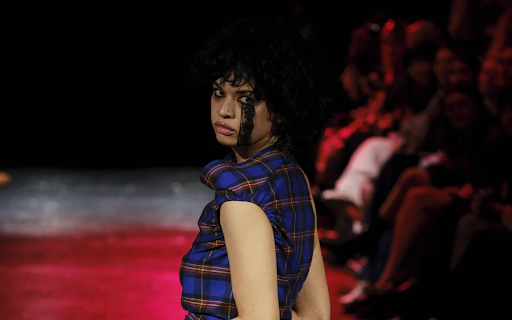
Photo: Ryan McKenna/Ryan Patrick Photography
Craft as Direction
Beyond aesthetics, there was a consistent return to craft.
Tuatara Studios, presenting FRAYED OPULENCE, focused on crochet and slow fashion practices, reinforcing the value of time and labor in an industry often driven by speed.
Similarly, across multiple shows — including Cisoco Bella’s CHIMÆRA — materiality remained central. Fabric, texture, and construction were treated not as secondary elements, but as the foundation of design.
This emphasis reflects a broader movement within Aotearoa New Zealand’s fashion: a return to local production, to handwork, to processes that prioritize meaning over scale.
More Than a Fashion Week
Te Wiki Āhua o Aotearoa does not position itself as an alternative to the fashion system. Instead, it operates as a redefinition of it.
It asks what fashion looks like when it is grounded in identity, in community, in history, when it is not detached from the people who make it.
The result is clothing that feels certain of itself. Not tentative, not trend-driven, but intentional.
A Different Kind of Future
In uncertain times, fashion often reflects instability. But here, the message was different.
Designers did not respond with hesitation. They responded with clarity, drawing from personal narratives, cultural references, and subcultural codes to create work that holds its ground.
In the end, Te Wiki Āhua o Aotearoa is not just about emerging designers. It is about a shift in perspective.
XOXO, The Fashion Stock Market