Every woman has heard it and grown up with it. The commenting on your clothes. The strict rules. The worries. “Cover your shoulders, it distracts boys.“ “You look too skinny/fat in this.“ “Men will look, you know that?“ “That‘s too much.“ Like we were designed to be liked by boys who wear the same shit every day. Summer is always hell. You have to choose in between dying from heat or getting catcalled or looked at weirdly or worse. But it doesn‘t matter, because even if you are wearing a thick winter coat, a scarf and a beanie, the same things still happen.
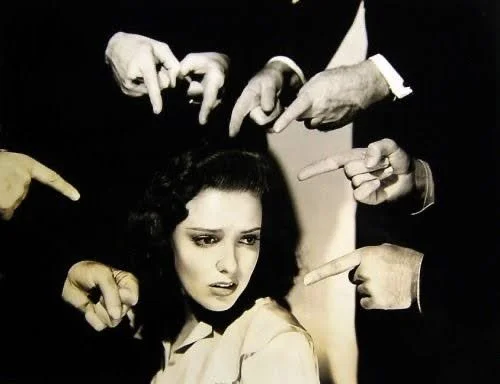
The Mirror Lie
It‘s a normal day. You wake up, do your morning routine and then, as final step (or penultimate, depends if you do eg. Make-Up after) you pick out your outfit. And normally you go to the mirror and look at yourself. While looking up and down at your own body, a million thoughts appear in your head, like “Is this too much?“, “I look fat in these jeans“, “I should plug my eyebrows“, “Am I showing too much skin?“, “Am I over-/underdressed?“, “Is this outfit safe?“ and so on.
We think we dress for ourselves. But do we really?
There are a lot of occasions where we choose to wear something boring (or just something we don‘t want to wear that day) just because it fits beauty standards and is “safe“. We try to hide something that doesn‘t fit the standards (and because of that, is an insecurity) and draw the attention to something that does fit. At some point we develop body dysmorphia, and 0,5-1% of women subsequently develop anorexia at least one time in their life. Anorexia in men is rarer and is often based on wanting to have a super trained muscle body (like muscle dysmorphia). Of all anorexic people, women make up about 90%.
Even though everyone is perfect in their own way, we always find something that‘s not.
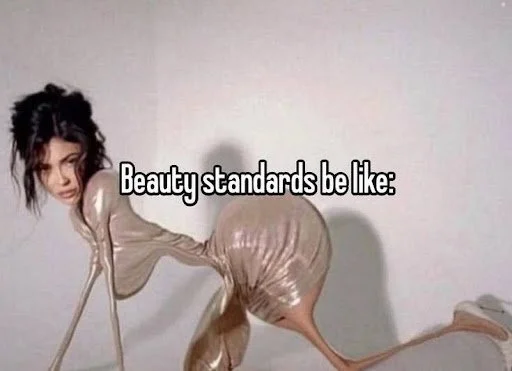
Who Invented Flattering Anyway?
In the beginning, “flattering“ meant making a body look thinner, taller and more conventionally proportioned. But today, it‘s a subject of modern, cultural debate.
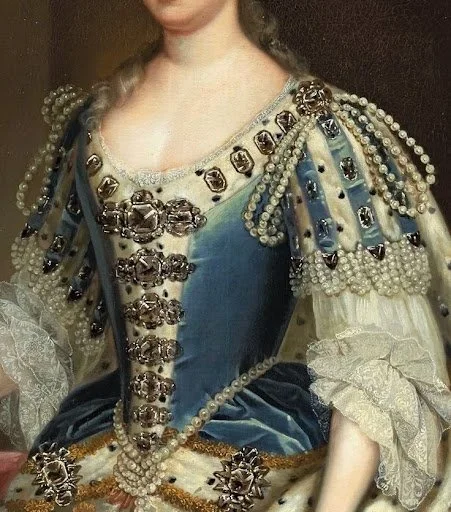
For centuries, clothing was made to manipulate the body, rather to fit it. In the 1800s, tight corsets, steel hoops and heavy petticoats were used to create a smaller waist (a so-called “Wasp-Waist“) and bigger curves. The tightness of the corset depended on the partner of the woman: if he could hug her waist with just his hands, then it was the perfect size. In the 1920s this idea of a female body shifted: athletic, adolescent flat figures with a flat chest (“Boyshform“/“Flat-O-Form“) were the new flattering. After, the “Stroutwear“-Era followed (1915-1930) where plus-size and “Stroutwear“ advertised tricks to help larger bodies to look slim (e.g. vertical lines, darker colours, etc). In the 1930s, many designers used “bias cutting“ to let fabrics glide over natural curves, focusing on motion and fluent draping. In the golden age of body-type rules, the late 20th century, women were told their specific body type (e.g. pear, inverted triangle, etc) and what to wear to hide the “flaws“ they had according to their body type. Then, calling an outfit “flattering“ meant slimming, it was some sort of a polite (and hidden) code.
But “flattering“ now is the new F-Word. Contemporary street style and runways (featuring oversized, drop-waist and voluminous shapes) reject the traditional proportion rules. There has also been a psychological shift: it is more important now to dress to express one‘s identity, rather than making the body conform to an expectation.
Even though “flattering“ is still a big subject, it‘s not as big as 200 years ago.
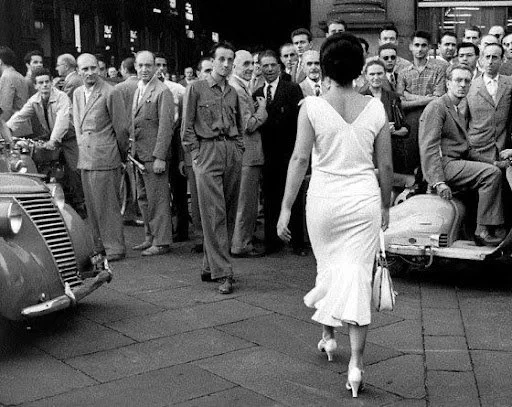
The Male Gaze In Your Closet
What we always thought we wear because it fits and looks good can also be through the male gaze. Who knows? Maybe our whole wardrobe is based on beauty standards, and we just don’t realise. A lot of popular clothing items are designed to show skin and focus on curves and often have shapes that are seen as advantageous to fit female beauty standards. Sometimes, unconsciously, we pick out outfits to get recognition from the male gaze, or to be ignored by it (e.g. additional jacket as security). From historical corsets to modern work and going-out dress codes, the image of women is often trained to be the object of observation.
The opposite is the female gaze, which concentrates on dressing for one's own and focusing on comfort and expressing identity.
But the Male Gaze will always be watching us…
Sexy vs. Sensual vs. Powerful
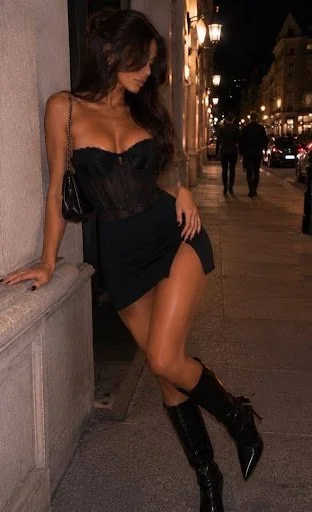
Sexy clothes depend more on the observer. The focus is shifted to skin and showing the body in general, using mini skirts, lingerie, etc. Modern interpretations focus more on body diversity and self-determination, rather than using cliches.
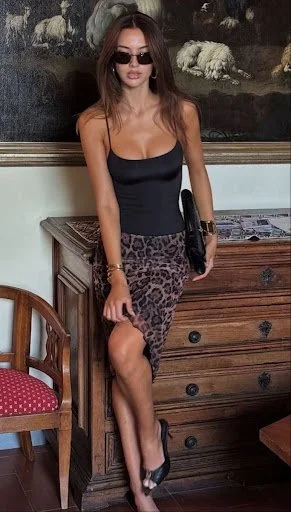
Sensual refers more to self-perceptive fashion, focusing on comfort. Used are soft fabrics like cashmere and silk, covered and harmonious colours and subtle cuts (e.g. backless). The effects are intus-oriented. You dress mainly for yourself and to create a calm and natural presence.
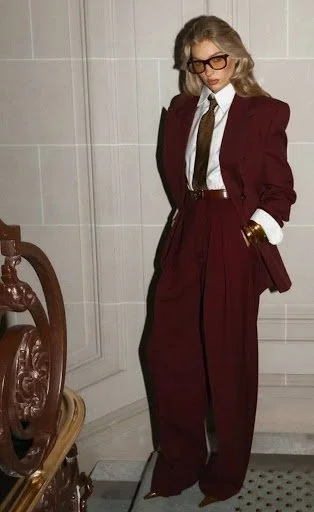
In one of my articles I already talked about the psychology of clothing and power dressing. Here, the main focus is to show authority, presence and (who would have guessed) power. Its characteristics are structured shoulders, sharp cuts, solid fabrics (like wool) and dark, elegant colors (like black, navy blue, etc). The goal is to look independent, (positively) unapproachable and professional. It works like a shield that signals competence and consciousness.
All of these forms can be combined.
But at what point do we really dress for ourselves? It‘s not like every designer wants to put all women in a patriarchal box (especially not the haute couture designers), but how can we ever truly know?
Algorithm = New Patriarchy?
Yes, algorithms are no objective mirrors of our society, actually, they can reinforce patriarchal systems and structures in a very new way. In science, this phenomenon is called algorithmical or digital patriarchy. This is because AI and social media algorithms learn from centuries of human texts, pictures and history in general. Back then, men were more dominant, so they perceive this as a “normal“ state of the world. Also, the majority of people working in the Tech-AI-Industry are men, so a lot of male perspective flows in unconsciously. Recommendation algorithms (like on TikTok) reward content that triggers strong reactions. Studies show that as a result, misogynistic or highly gender-stereotypical content is rapidly gaining in reach. This does not only affect social media, it also affects everyday decisions, like when they review applications, men are favoured by AI because they are based on data of more successful (historically male-dominated) employees. Also in credit scoring and in health they give women lower credits or are more oriented on male symptoms (because there was more research on men). But the patriarchy was not invented by AI, it just accelerates and camouflages it. A new “Feminist AI“ is in the making, to break up these mechanisms.
A Wardrobe Of One‘s Own
At this point, I don‘t even know what that is. I‘m starting to question everything I've ever worn.
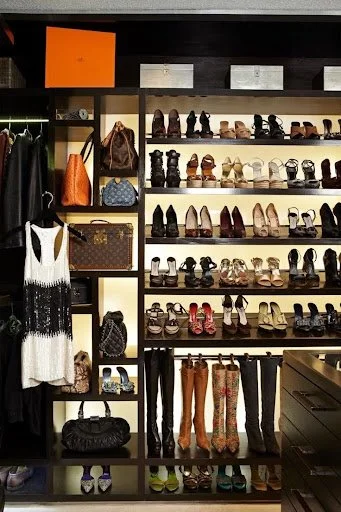
Key points are your feelings and, sadly, also your security. It should not be like that, but until things change, we kinda have to protect ourselves. Independently from the things that were designed just to please the Male Gaze, dress how you want to, even using these items. In the end, you just have to dress in a way that you enjoy. As long as you like your wardrobe, the colours, the fabrics, the cuts, etc., your personal style is the most important thing in expressing yourself.
XOXO, The Fashion Stock Market