When Style Leaves the Ice
On screen, Heated Rivalry is about tension: between players, between teams, between desire and discipline. But off the ice, a different kind of rivalry has begun to take shape: one that plays out not in arenas, but in fashion.
As the series gained momentum, its stars stepped into a new kind of visibility. No longer confined to jerseys, locker rooms, or press conference suits, they entered a space where image matters just as much as performance. And in that space, clothing has become something else entirely.
From Uniform to Identity
In professional hockey, style has historically been restrained. For decades, players were expected to arrive in uniformity, suits, ties, a controlled image that left little room for individuality. Fashion, in this context, existed outside the sport, almost as if in a separate system.
What Heated Rivalry does - both on screen and through its cultural impact - is disrupt that separation.
Off the ice, its actors present a different visual language. Tailoring becomes sharper, silhouettes more intentional, details more expressive. The shift is subtle but significant: clothing is no longer about fitting into a system, but about standing out from it.
The Rise of the Off-Rink Persona
As the show’s popularity expanded, so did its presence in fashion spaces. Appearances at events, runways, and front rows began to position its cast not only as actors, but as style figures.
At Milan Fashion Week, this transition became particularly visible. What was once a sports narrative moved directly into the center of the fashion system, a space defined by visibility, image, and influence.
This movement reflects a broader shift: athletes - or those who represent them on screen - are no longer confined to performance. They are part of a larger cultural economy where fashion plays a central role.
A New Aesthetic: Between Discipline and Expression
What makes this moment interesting is not just visibility, but contrast.
Hockey, as a visual culture, is built on structure: uniforms, padding, repetition, control. Fashion, by contrast, thrives on variation, experimentation, and self-expression. When these two worlds meet, the result is a new aesthetic, one that balances rigidity with fluidity.
Designers have begun to engage with this tension. Elements traditionally associated with the sport — oversized silhouettes, layering, protective structures — are reinterpreted through a fashion lens. What was once purely functional becomes stylistic.
This is not about transforming hockey into fashion, but about recognizing that the visual language of sport already contains the elements fashion seeks: movement, texture, and contrast.
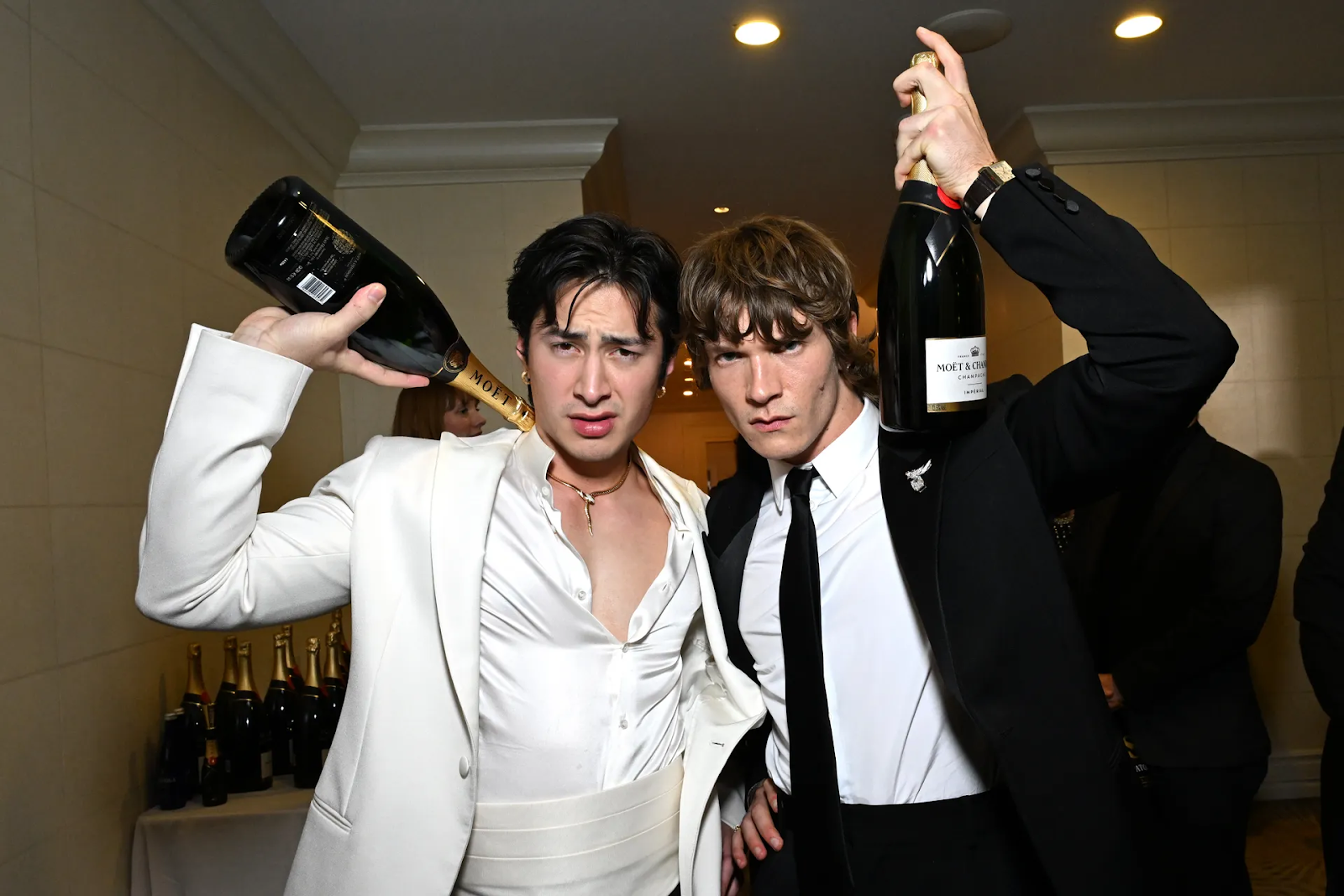
Hudson Williams and Connor Storrie at the 83rd Annual Golden Globes
Michael Kovac/Getty Images
Beyond the Show
The impact of Heated Rivalry extends beyond its narrative. It contributes to a cultural moment in which sport, entertainment, and fashion increasingly overlap. The boundaries between these industries are no longer fixed, they are porous, constantly shifting.
Off the ice, style becomes part of storytelling. It shapes how audiences perceive identity, not just character. And in doing so, it reflects a broader change: one where clothing is no longer secondary to performance, but part of it.
More Than a Moment
This is not just about one show, or even about hockey. It is about a shift in how masculinity, sport, and visibility are presented. Where uniformity once dominated, individuality now emerges, carefully styled, publicly consumed, and culturally significant.
In the end, the most interesting rivalry may not be the one played on the ice, but the one unfolding outside of it, between tradition and transformation, between uniform and expression.
XOXO, The Fashion Stock Market