Women’s costuming in film
In traditional film production, costumes have a way of telling us an entire story only by the clothing pieces. We look towards the characters outfits as a means of their expression, as well as a greater sense of storytelling. In studying how costuming is so vital, we can look closer at individual items and how they enforce certain gender tropes.
As individuals, we dress based on our own forms of self expression, but in film styling is intentional. The character does not have autonomy in the same way and so much of costuming is left up to stereotypes.
The two stereotypes that women are most often attributed to are the overly sexual and devious vs. the matronly and kind archetypes. The stereotype of the young and naive girl is also very present.
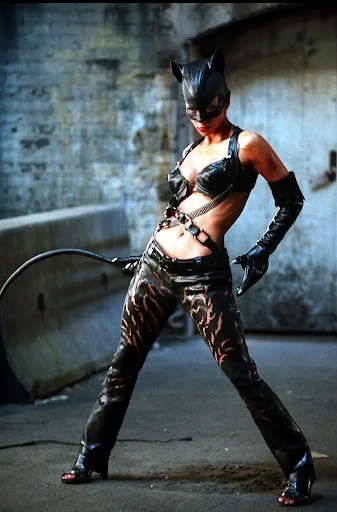
Halle Berry as Cat Woman (2004)
Though this movie is considered pretty negatively, all around it serves as a particularly good example of the devious/sexual stereotype. This outfit truly makes zero sense logistically, no one would ever wear pleather pants with rips in them and open toed shoes to commit crime. She is nothing beyond the sexual and devious character she is costumed as.
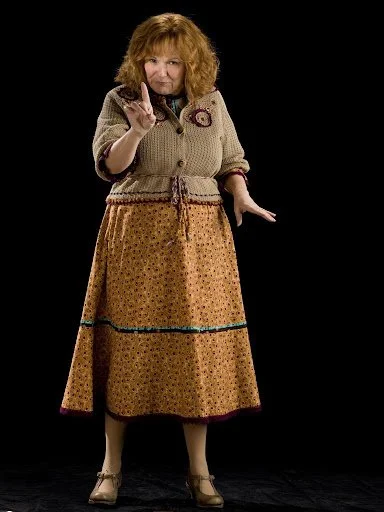
Julie Walters as Molly Weasley (2001)
Molly Weasley does not demonstrate the classic matron archetype, as she is not excessively kind and warm. She’s not afraid to yell at her kids and is quite a frazzled woman. Though her clothing tells us otherwise. She is figureless and covered from head to toe. She is not meant to be perceived as a sexual being at all, only as one to nurture the main male character. Her clothing tells us before she opens her mouth she is a character to be trusted. Her clothing is soft and gives the viewers this comfortable feeling of nurture.
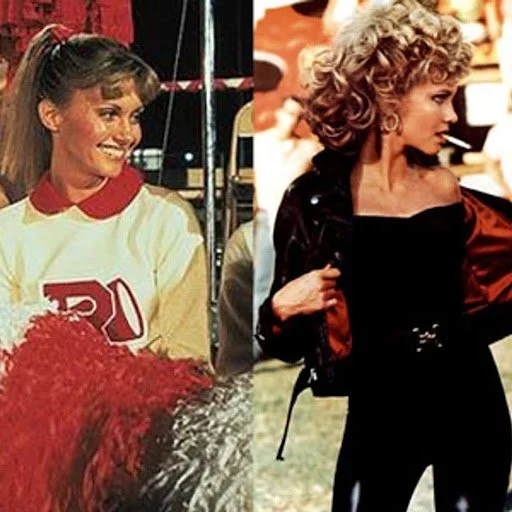
Olivia Newton-John as Sandy (1978)
The final way in which women are costumed in film is as youthful and naive. This is the character we are supposed to sympathize with, they don’t understand the world. And so the clothing is usually a bit awkward, either ill fitting, too covered up, or completely out of style. Sometimes these stay costumed awkwardly and the character arc revolves around being naive. The other alternative is they began to learn how to act socially and move into one of the other tropes (usually sexual and devious). Sandy is an especially good example of this as throughout the whole movie she’s treated as silly. She’s not grown up enough and lives in a fantasy world. By the end of the film she learns the truth of her love interest, and becomes very sexually to show she has moved away from naivety.
Many of the ways in which women are costumed rely heavily on real-world stereotypes. As we have become increasingly progressive as a society, these clear lines aren’t as distinct. As more complex female characters are written their clothing becomes more nuanced in turn. Next time you watch something pay close attention to the clothing and what tropes the media is trying to push through their characters.
XOXO, The Fashion Stock Market