The Valentino Effect: How Vision Became an Iconic Brand
On the 19th of January 2026, Valentino Garavani, one of the most influential names in fashion, passed away at 93. With his death, the world didn’t just lose a remarkably talented designer but also a visionary mastermind. His legacy cannot be measured in dresses alone; the world remembers him for a brand so meticulously crafted, so instantly recognizable that it redefined what a fashion house could be. He was known as “The Last Emperor” —the guardian of timeless elegance— or, as journalist Hamish Bowles describes it, “he had conquered the worlds of fashion and style, bringing a certain idea of beauty to whatever he touched.” While he is gone, his brand remains a symbol of timeless luxury and powerful femininity.
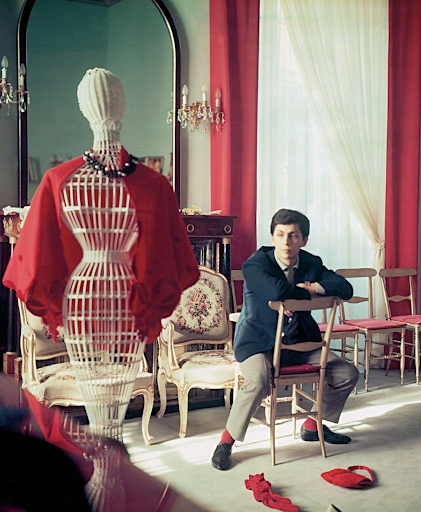
Valentino in his workshop in Via Gregoriana
Photo: Harper’s Bazaar
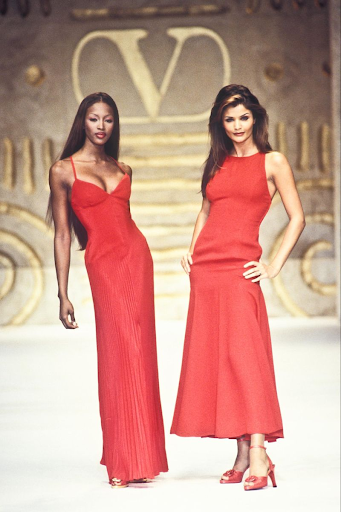
And when we think of Valentino, we think of red, the most iconic signature of his brand. While many brands have signature colors, Valentino Red stands out with its story and role as the core of one of the strongest brand identities in fashion. Valentino’s red obsession traces back to his teenage years. When he went to see Carmen by Georges Bizet in Barcelona, he saw that most of the costumes and decor were red, particularly one woman whom he was mesmerized by. That’s when he thought that if he ever became a fashion designer, he “would do lots of red”. One of his most famous quotes says, “I think a woman dressed in red is always wonderful. She is the perfect image of a heroine.” The red wasn’t only feminine, but it was bold and powerful. This duality made up the central aesthetic of the brand.
Years later, in 1959, Valentino launched his first collection, and one of its pieces was “La Fiesta”, the first red dress of the brand. With its strapless neckline and bright red tulle, the dress gained instant recognition, making his name known in the industry. Since then, each collection featured at least one red dress, creating a tradition alongside a vision for the brand. His partner, Giametti, told Vogue once that Valentino had “superstitions that became status symbols.” He also wrote in his book, Valentino Russo, that red was his good-luck charm. For Valentino, red wasn’t just a color, but it was the brand’s soul. By consistently dressing women in red, Valentino made sure the color was not only fashionable but iconic. Soon, it left a significant cultural impact by dominating the red carpet and becoming inseparable from the brand’s name.
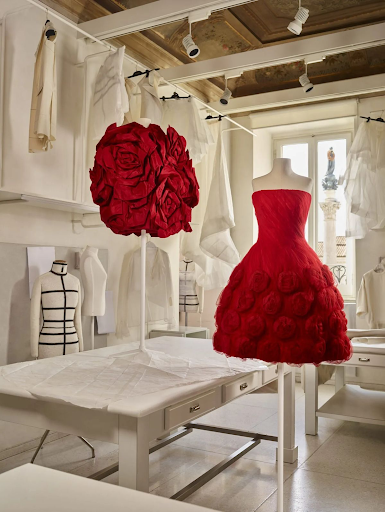
“La Fiesta” by Valentino Garavani
Valentino Runway Show SS 1993 Naomi Campbell & Helena Christensen in Valentino Red
Photos: Pinterest
Valentino’s designs and brand identity were also made unforgettable through iconic wearers. Throughout the brand’s history, it has been known for dressing celebrities from royalty to A-list actresses. Valentino’s celebrity dressing was more than glamorous; it strategically carried Valentino’s branding to a much higher level. One of the most well-known examples would be Jackie Kennedy’s wedding dress, which she wore for her second wedding in 1962. Besides her, many cultural milestones had a touch of Valentino: Julia Roberts had on an opulent black and white dress from Valentino when winning her Oscar, a moment that was later described by the designer as one of the proudest moments of his life; Princess Diana wore a beautiful velvet burgundy Valentino dress in 1992 to the Hong Kong Gala, and one of Sharon Stone’s many iconic looks was when she attended the 1995 Cannes Film Festival in a Valentino gown. Women like Audrey Hepburn, Jennifer Aniston, Anne Hathaway, and many more had unforgettable moments in Valentino. The elite circle Valentino built established both prestige and global visibility, positioning the brand as aspirational but not cold. Celebrities, acting as living billboards, made the designs a part of life events and created memorable moments. From the earlier days of Valentino, the brand became culturally relevant through these appearances and formed a profile in the public eye.
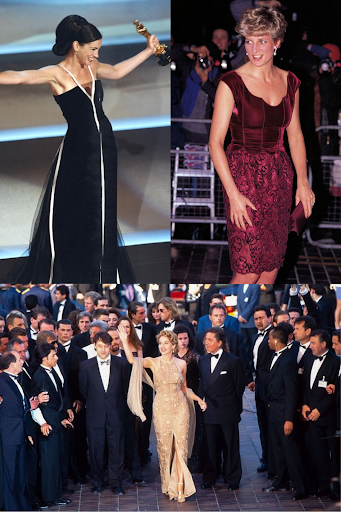
Julia Roberts at the 73rd Academy Awards (2001), Princess Diana at the Hong Kong Gala (1992), Sharon Stone and Valentino at the Cannes Film Festival (1995)
Photo: Vogue
Dominating the red carpet and his signature color weren’t the only strategic moves Valentino made to build a powerful brand identity. Visibility alone does not form legacy, but Valentino’s garments sustained the myth. Since the beginning of his career, Valentino kept a consistent atmosphere in his designs. He used romantic and elegant silhouettes aimed to elevate femininity. His philosophy has always been about beauty, in his words: “I know what women want, they want to be beautiful.” He stuck to this ideology throughout all of his collections and refused to shift his aesthetic based on trends. The designs coming from the same outlook established a visual DNA for the brand, securing long-term recognizability. Along with visual appeal, the garments offered an experience. They cultivated the beauty by giving wearers presence and confidence. This sensation was central to brand identity because it turned clothes into lasting impressions.
The concept of simple yet sophisticated beauty extended beyond his designs. Valentino’s logo —a minimalist serif font paired with a magnified emblem— was another detail communicating opulence. The effortless V was an unmistakable link to Valentino. The visual continuity of his ideology and aesthetic through different aspects of the brand reinforced another signature for Valentino: the brand became one with timeless luxury, beauty, and style.

Valentino’s Logo
Photo: Pinterest
Every element of the brand Valentino constructed was intentional. Together, created a cohesive story that resulted in an exquisite brand identity. The color, silhouettes, cultural placement, and visual identity: the Valentino brand is something far larger than fashion collections. It is the equivalent of elevated composure in the fashion world, and proof that Valentino Garavani was not just a designer, but a genius of a brand architect. His brand outlives him as one of the most legendary and iconic fashion houses in history. He made luxury visible and aspirational, and his legacy will forever be immersed in culture.
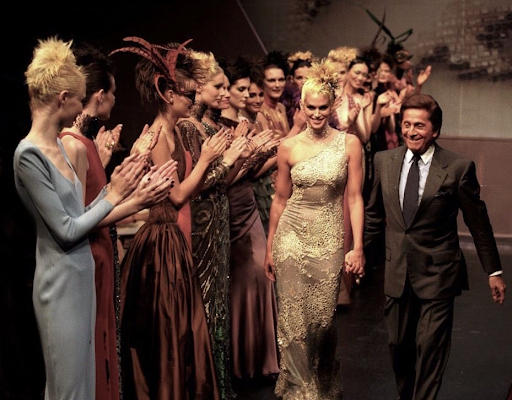
Valentino and Cindy Crawford at the A/W Haute Couture 1997-1998 show in Paris
Photo: Vogue France
XOXO, The Fashion Stock Market