The Misunderstood Realm of Fashion
Quite often on my Instagram feed I come across memes like the one mentioned below as a light-hearted fashion-tech-focused reminder and encouragement. At the first few glances, it can actually come off as funny, relatable and even inspirational to the right audience. But upon reflection, we realise that beyond all the wit and giggles lay some deeper, harsher concepts.
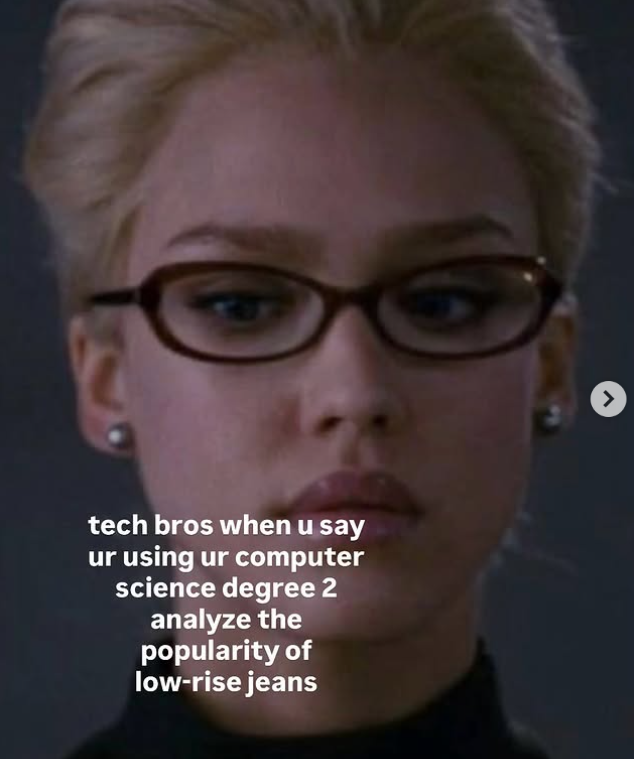
Photo: databutmakeitfashion/Instagram
These memes tend to serve as a satirical jab at the perceptions of fashion as a frivolous and ephemeral working domain. And as much as we’d hate to admit, that quite literally is how the field is still viewed by some people and communities. Society has reduced this extraordinary amalgamation of complex processes like craftsmanship, design, analysis, business and technology to a mere black-and-white perception of ‘making and selling clothes’. As most people are only witnesses to the final products of the industry and remain oblivious of the labour and intelligence that go into the creation of clothing pieces, it becomes quite easy to disparage the industry and underestimate the intensity, versatility and dynamism of it.
As stated by Professor Frances Corner in the Google Arts article titled ‘Why Fashion Matters’, one of the things Fashion can do is spread an idea around very powerfully, coherently, and with the all-important ‘cool’ factor. It is one of the most prominent factors for portraying who we are, how we view the world and what we aspire to be. Undermining such a personal form of pursuit means undermining millions of hours of traditional artistry, and the techniques that artisans have spent years practicing. Whether it’s the Hand Embroidery from the craftsmen of the villages of India or the Couture Collections from the luxury runways in Paris, each crafted piece narrates a story of its own and forms a personal connection to all of us. With the usage of texture, symbolism and composition in the field prove that Fashion is, indeed, Art.
Needless to say, it doesn’t stop here. One of the core complexities of a domain like Fashion involves the intersection, interconnection and interdependence between Art & Craftsmanship and commercial disciplines like Business, Technology, Psychology, and Marketing. The domain itself is an established commercial industry valued at $3 Trillion globally, generating an annual U.S. revenue of more than $200 Billion, and directly employing over 57 million people worldwide. Hence, contributing significantly to the economy and the workforce. Speaking of economy, concepts like the Lipstick Index and the High Heel Index are two fascinating examples of how fashion and consumer behaviour have been studied in relation to economic cycles. The domain also constitutes rigorous research & analysis cycles, observation of consumer behaviour, trend forecasting and marketing campaigns to identify what the market wants and design collections accordingly. Hence, what the consumers choose to purchase as their favourite items from the retail stores are almost always the results of these creative, analytical and commercial processes, as described very well by the character Miranda Priestley in The Devil Wears Prada (2006).
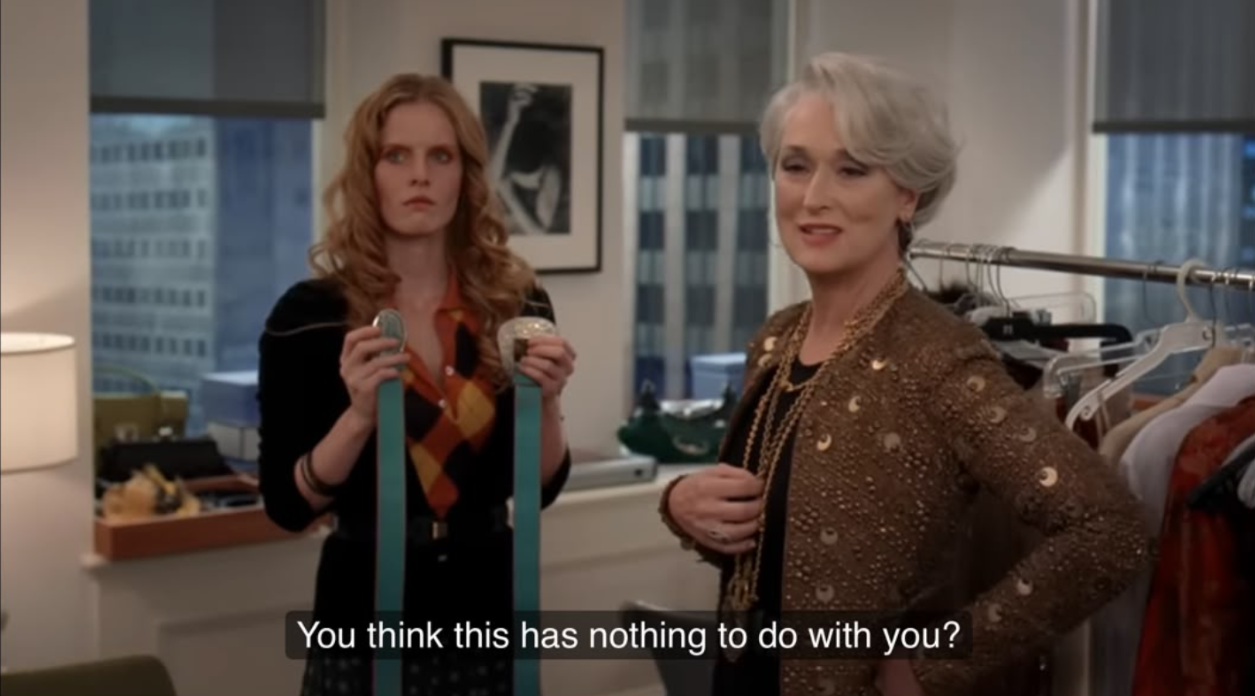
Photo: The Devil Wears Prada (2006)
In an era where technology is capable of taking over forms of technical and analytical labour, human creativity, interpretation and expression are likely to become much more prominent. Working in such an industry requires as much talent, technique and expertise as any other, if not more. It is important that people working in these fields are respected as much as the other ‘more serious’ jobs. Fashion will always be an integral part of our existence and workforce as a vibrant, dynamic and multifaceted domain which has the potential to change and shape lives through its connection to us all.
XOXO, The Fashion Stock Market