The Secret Language of Ring Placement
Throughout the course of history, jewelry has remained a constant companion to ever-evolving fashion. From the grandest of neck adornments to the tiniest of stud earrings, different pieces of jewelry have each found their respective places within time. But none have been more utilized than that tiny loop of metal we call a ring. Interestingly, as time developed, the placement of the ring grew to become more significant than the ring itself. In fact, each finger has grown to have a particular meaning within today’s world.
Thumb rings have long been associated with wealth and status. Ancient archers are said to have worn these for protection when shooting, giving them an air of power. Because thumb rings are often larger and more conspicuous, they have also long been associated with wealth, confidence, and status.
Embellishment on the index finger has a much more controlled feel while still retaining power. In Medieval Europe, nobles often wore signet rings - rings with the engraving or inscription of a family crest- on this finger. It has become a position of authority and influence and in modern times, the perfect finger for that chunky statement ring.
The middle finger is a completely different story. Unlike the others it has developed few widely accepted symbolic meanings. Therefore, its highly visible position can oftentimes be used for the wearer to showcase a bit of personality. Usually small in order to balance the hand, this can be a trinket from a souvenir shop or your great grandmother's ring. Either way, it should mean something special to the individual and communicate their personality to those who meet them.
Now for what you’ve all been waiting for, the ring finger. For centuries, Ancient Romans believed that the vena amoris or, “ vein of love” ,ran directly from the left ring finger to the heart. Though science eventually proved this wrong, the tradition still survives today. Engagement rings, wedding rings, and more can be found on this finger everywhere you look. In places such as Germany, Russia, India, Greece, and parts of Eastern Europe its counterpart on the right hand can signify just about the same thing. Though the hand varies by culture, the ring finger will forever hold a certain romantic air, symbolizing commitment to the ones we love.
If the ring finger speaks of commitment, the pinky finger speaks of identity. For centuries the smallest finger has carried the most significant of jewelry’s messages. Although signet rings were historically worn on the index finger of rulers and nobles, they became most closely associated with the pinky finger in later centuries. In fact, 18th century gentlemen would often wear a signet on their pinky to represent their societal affiliations or family, helping to transform the pinky ring into the symbol of heritage, family identity, and old-world prestige it is today.
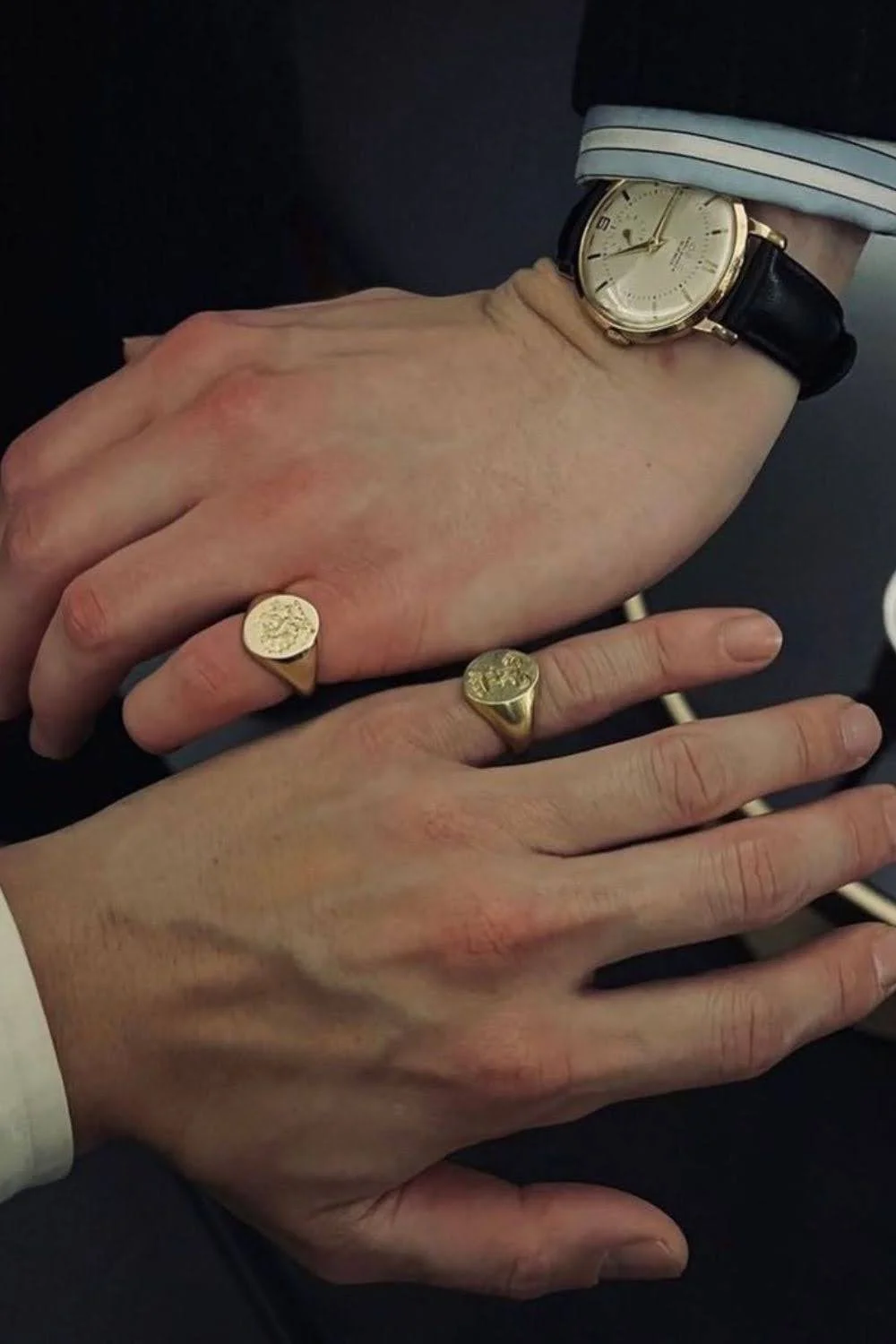
Photo: Pinterest
While ring placement may seem insignificant at first glance, history suggests otherwise. And it doesn’t just stop at placement. There are hundreds of other intricacies constructed by the societies of ancient worlds. Take ancient Egypt where officials wore rings to show rank or even Renaissance courts, where gem- heavy rings became portable wealth. No matter the purpose, stone, size, or shape, rings remain one of the most prevalent tools for self expression, wealth indication and individualistic communication.
XOXO, The Fashion Stock Market